
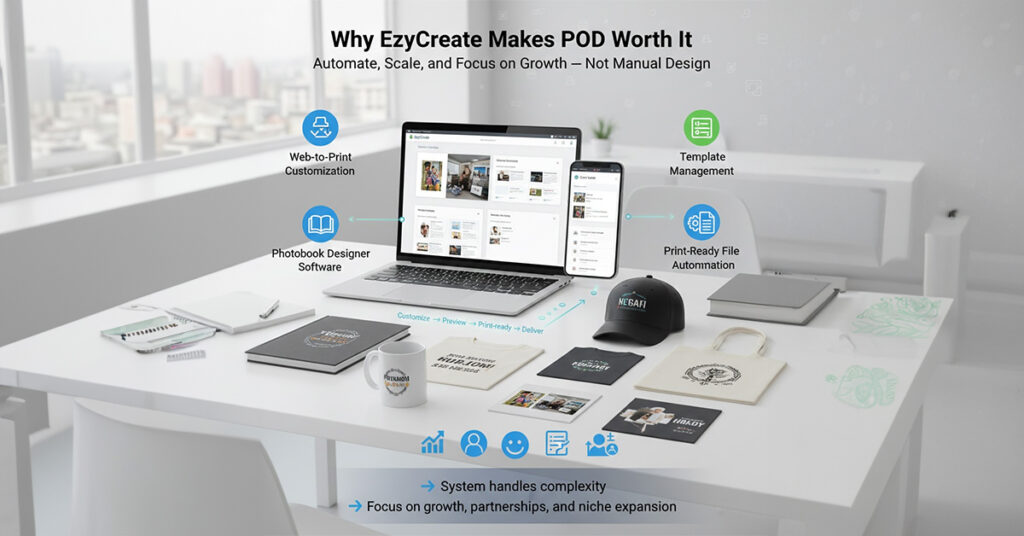
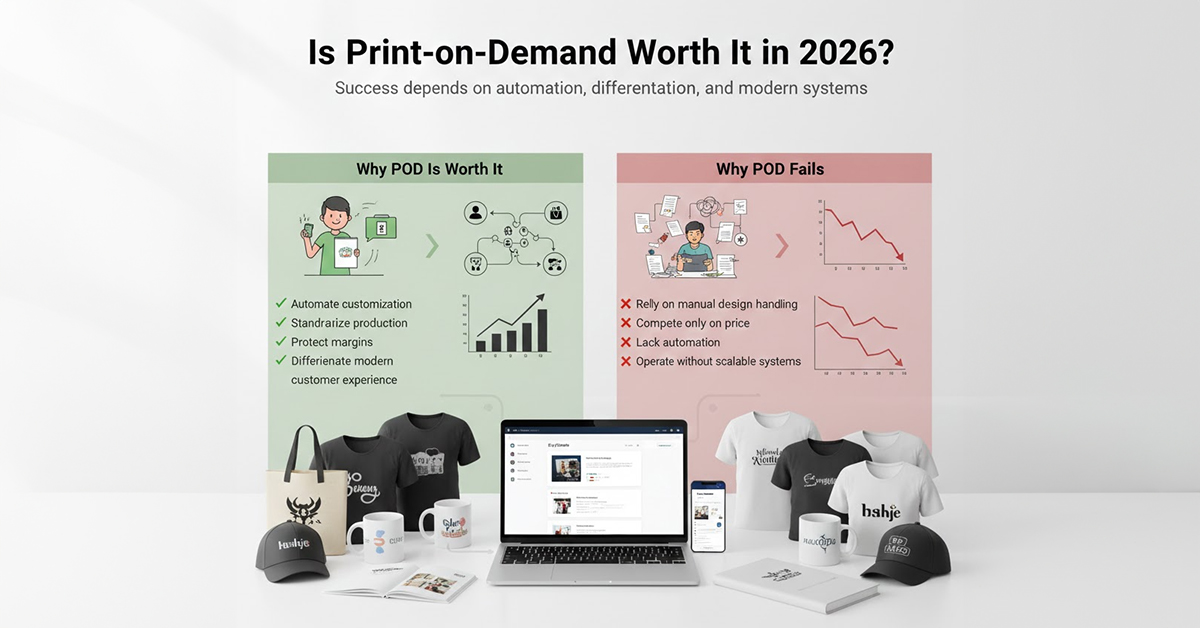
Is print on demand worth it in 2026? Yes, but only for businesses that build the right systems around customization, automation, pricing, and customer experience.
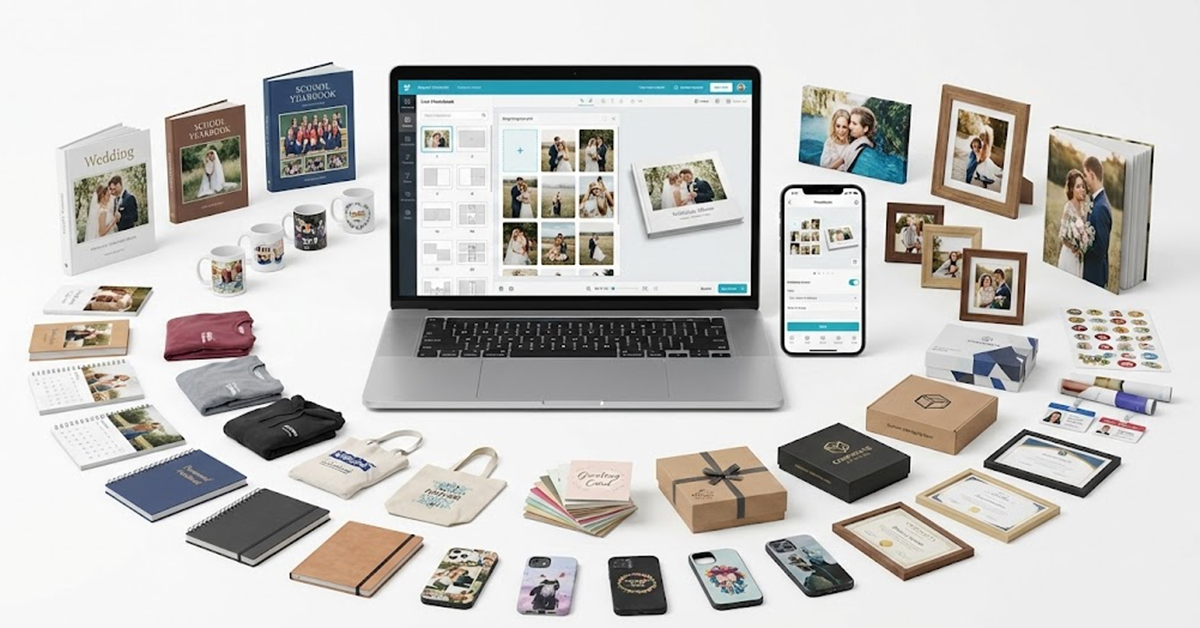
Print on demand is no longer just a side hustle trend. In 2026, it is a serious business model used for custom photobooks, school yearbooks, personalized merchandise, corporate gifting, and creator-led brands. The demand is still there, but the market is more competitive, margins are tighter, and customer expectations are much higher than before.
That is why the real question is not just whether POD still works. The better question is this: can a business build a print-on-demand setup that is efficient, scalable, and profitable? This guide explains the print on demand pros and cons in 2026, the best print on demand niches in 2026, and why automated workflow now plays a major role in long-term growth.
Print on Demand Pros and Cons in 2026
Before deciding if print on demand is still worth it, it helps to look at the real advantages and limitations of the model.
Pros of Print on Demand in 2026
One of the biggest benefits of print on demand is low inventory risk. Businesses do not need to keep large amounts of stock before getting orders. This makes POD easier to start and easier to test across multiple categories.
It also works well for personalization. Customers today want custom products, live previews, and flexible design options. That makes print on demand especially useful for photobooks, gifts, school products, and branded merchandise.
Another major advantage is scalability through automation. Businesses with the right systems can reduce manual work, improve order accuracy, and handle growth more efficiently.
Cons of Print on Demand in 2026
The downside is that print on demand is no longer easy money. If the workflow stays manual, the business quickly becomes difficult to manage. Design revisions, production errors, support requests, and slow approvals can reduce profitability.
Generic POD stores also face heavy competition. When businesses sell the same products without clear differentiation, they often end up competing on price. At the same time, ad costs and marketplace commissions continue to put pressure on margins.
So while POD still offers opportunity, the results depend heavily on how the business is structured.
Why Automated Workflow Matters in Print on Demand in 2026
In 2026, workflow is one of the biggest factors that separates profitable POD businesses from stressful ones.
Many sellers assume print on demand is passive, but that only happens when the system is automated. If every order needs manual design checks, print file preparation, and back-and-forth approval, the business becomes harder to scale.
An automated workflow helps with:
- print-ready PDF generation
- standard bleed and margin setup
- product and size rules
- order routing and production steps
- template-based customization
This saves time, lowers error rates, and reduces dependency on internal designers.
For businesses exploring print on demand niches in 2026, automated workflow becomes even more important. Niche products often involve more customization, more brand rules, and higher customer expectations. Without automation, these categories are harder to grow profitably.
Print on Demand Business Pros and Cons in 2026
When looking at print on demand business pros and cons in 2026, it is important to think beyond products and focus on the actual business model.
Business Advantages of Print on Demand
POD allows businesses to launch faster without investing heavily in inventory. It also makes it easier to test categories, respond to trends, and expand into new customer segments.
The model works especially well for businesses that want to offer personalized products at scale. For printers, ecommerce brands, schools, and gifting businesses, POD can support repeat orders and category growth.
Business Challenges in 2026
The main challenge is profitability. If the business depends too much on manual design support, uncontrolled product variations, and slow production handling, the model becomes expensive to run.
Rising ad costs, high customer expectations, and heavy competition also make it harder for businesses to win with generic products alone. That is why POD businesses in 2026 need stronger control over operations, pricing, and differentiation.
The 5 Things You Must Control to Make Print on Demand Worth It
1) You Must Control Your Customization Experience (Web-to-Print matters)
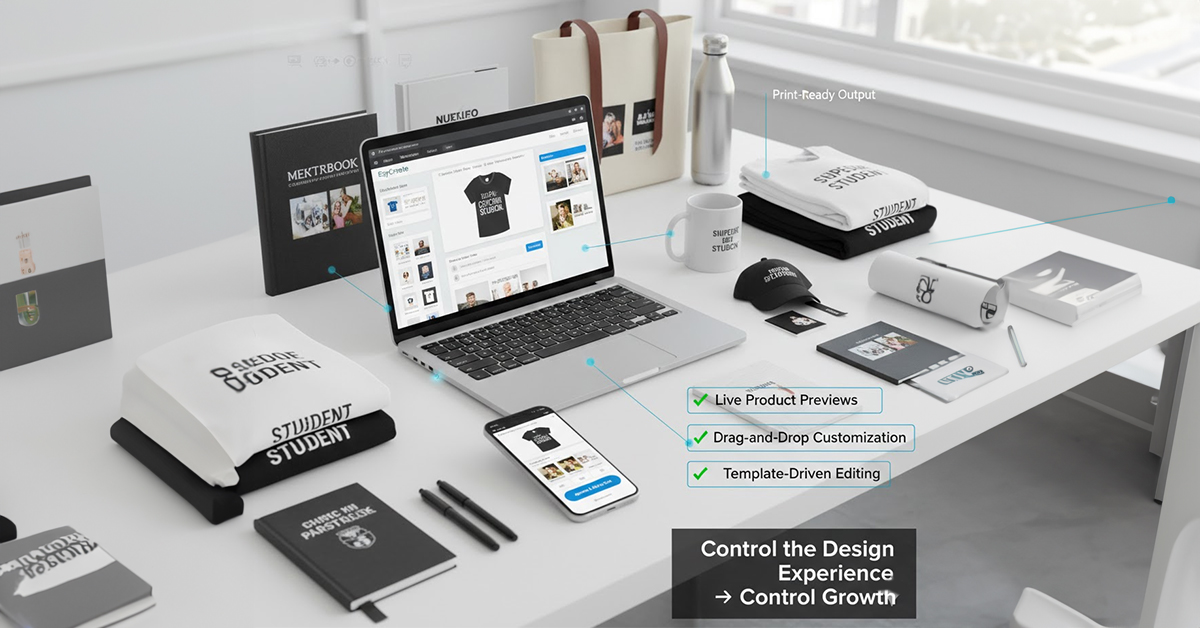
In 2026, customers don’t want to:
- Email files
- Wait for design previews
- Approve changes over WhatsApp
- Go through multiple revisions.
They expect:
✔ Live product preview
✔ Drag-and-drop customization
✔ Instant layout changes
✔ Mobile-friendly design tools
If you fail to provide a seamless web-to-print experience, your customers will look elsewhere. So, the question is: are you offering an experience that delights your customers and makes designing easy?
Why it impacts print-on-demand profitability
Manual customization:
- Slows order processing
- Increases design cost
- Reduces scalability
- Causes errors
Modern print-on-demand automation handles all of this, reducing manual workload and enabling customers to design products themselves, all while maintaining control over your brand.
What to do
Use web-to-print software that lets customers personalize products themselves while you keep brand control (templates, rules, safe areas).
How EzyCreate Helps
EzyCreate provides:
- Advanced web-to-print product designer
- Multi-page photobook editor
- Template-driven customization
- Real-time product preview
- Print-ready output generation
This reduces manual workload and allows customers to design products themselves — without sacrificing brand control. Control the design experience, and you control growth.
2) You Must Control Print On Demand Automation (the backend decides scale)
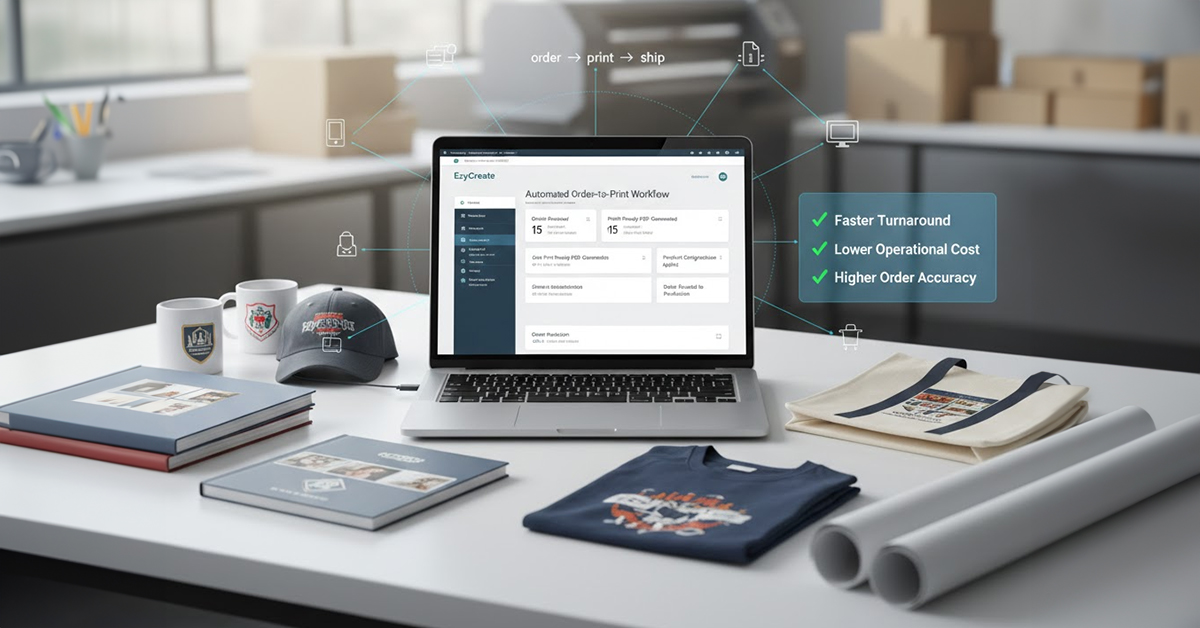
Many people think print on demand is passive. It’s not—unless you automate.
If your backend workflow is manual:
- Orders require file adjustments
- Designers must prepare print-ready files
- Production mistakes increase
- Profit drops
What Smart Print-on-Demand Businesses Automate
They automate:
- Print-ready file generation (PDFs)
- Standard bleed & margins
- Size and product configurations
- Order routing / production steps
Print-on-demand automation reduces turnaround time and saves cost per order—this is key to a scalable print business. This removes dependency on internal designers.
EzyCreate Advantage
With EzyCreate:
- Print-ready PDFs are generated automatically
- Templates standardize layouts
- Product configurations reduce errors
Result:
✔ Faster turnaround
✔ Lower operational cost
✔ Higher order accuracy
Automation is not optional in 2026; it’s survival.
3) You Must Control Your Margins (or Print On Demand isn’t worth it)
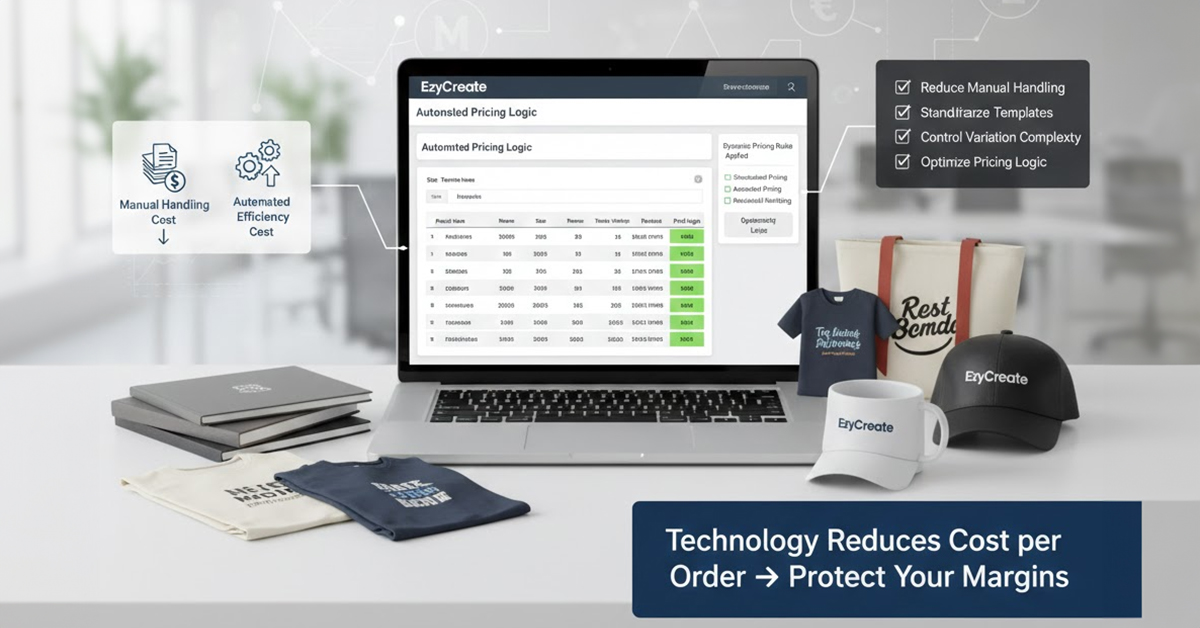
Let’s talk numbers.
In 2026:
- Ad costs are rising
- Marketplace commissions are high
- Competition undercuts pricing
If your workflow is inefficient, your profit disappears.
Where Most Print-on-Demand Businesses Lose Money
- Manual design time
- Too many revisions
- Small production inefficiencies
- Poor pricing structure
What to do (simple margin protection rules)
- Reduce manual work using templates + automation
- Limit uncontrolled variations (size, layouts, customization options)
- Create pricing logic: base price + customization premium + rush fee
- Track cost per order (design time + production + support)
If you don’t control margin, “print on demand profitable” becomes a myth.
4) You Must Control Product Differentiation (generic print-on-demand businesses are dying)
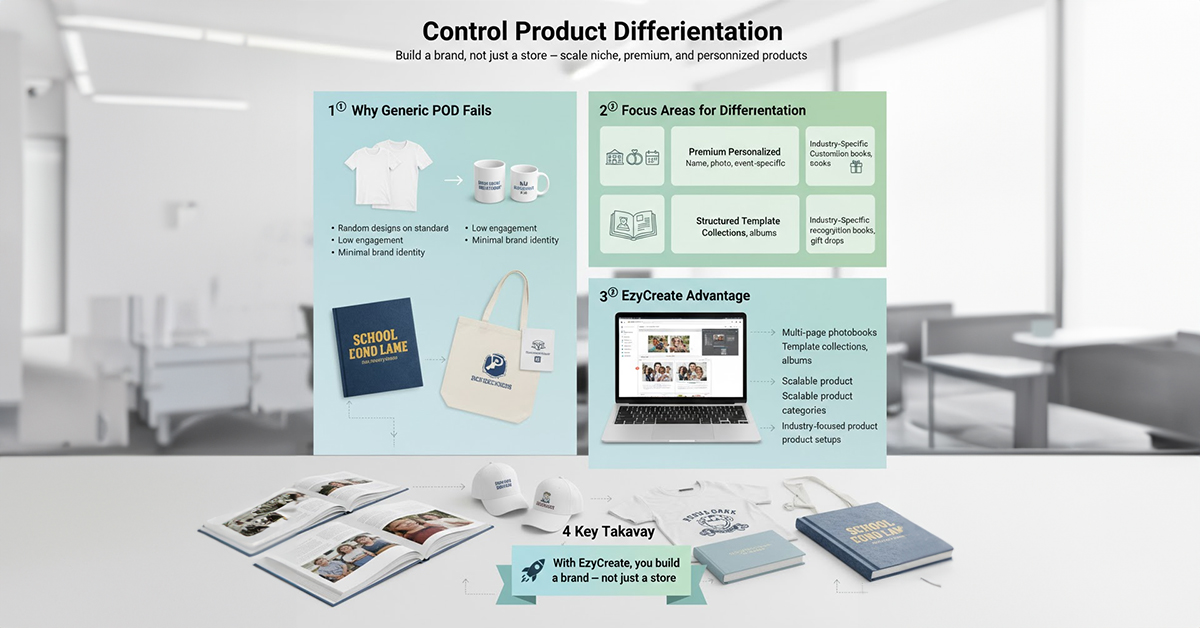
Generic print-on-demand stores are dying. Uploading random designs on generic products isn’t enough anymore.
Winning print-on-demand brands focus on:
- Niche markets (schools, weddings, corporates)
- Premium personalized products
- Structured template collections
- Industry-specific customization
Examples:
- School yearbook platforms
- Corporate recognition books
- Creator-led photobook drops
- Personalized gifting solutions
Differentiation keeps you away from price wars and makes your print-on-demand business worth it long-term.
Why EzyCreate Supports Differentiation
EzyCreate is not limited to single-page merchandise.
It supports:
- Multi-page photobooks
- Template collections
- Industry-focused product setups
- Scalable product categories
This allows you to build a brand — not just a store.
5) You Must Control Customer Experience (trust drives repeat sales)
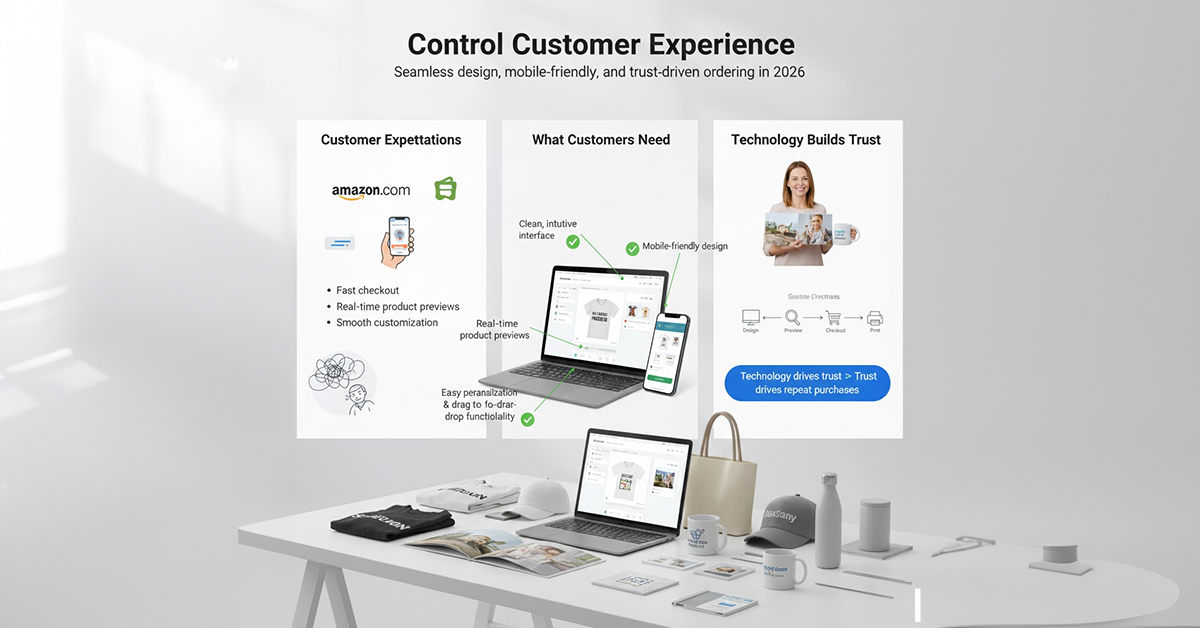
In 2026, customer expectations are shaped by:
- Amazon speed
- Shopify checkout
- Clean mobile experiences
- Real-time previews
If your POD workflow feels outdated, trust drops.
You need:
✔ Clean interface
✔ Mobile optimization
✔ Seamless customization
✔ Clear product previews and checkout
Technology drives trust. And trust drives repeat purchases.
Why EzyCreate Makes Print on Demand Worth It in 2026
EzyCreate helps businesses build a more structured print-on-demand system instead of relying on manual processes.
With EzyCreate, businesses can manage:
web-to-print customization
multi-page photobook editing
template-based product setup
real-time preview
print-ready output generation
scalable product configuration
This makes it easier to reduce manual work, improve order accuracy, and grow across multiple personalized product categories.
For printers, ecommerce sellers, and brands looking to expand into custom products, EzyCreate supports the kind of infrastructure needed to stay competitive in 2026.
The Real Shift in 2026: From Hustle to Infrastructure
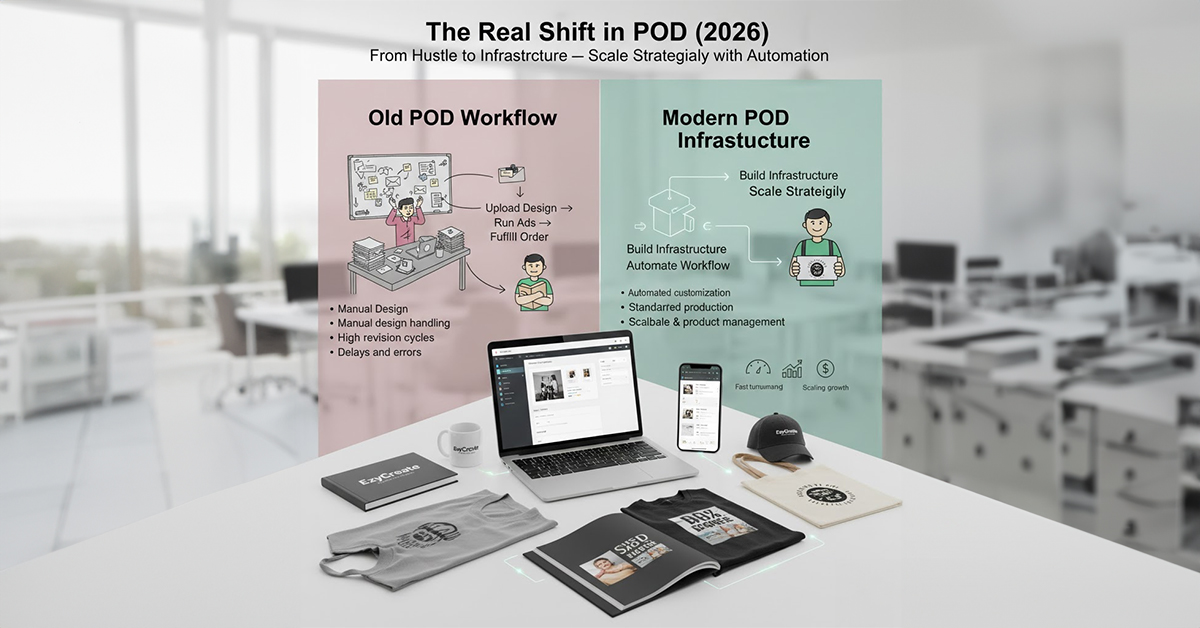
Earlier, print-on-demand business was about:
“Upload design → run ads → fulfill order”
Now it’s about:
“Build infrastructure → automate workflow → scale strategically”
That’s why web-to-print software + POD automation matters more than ever. That’s where platforms like EzyCreate become critical.
Final Verdict: Is Print on Demand Worth It in 2026?
Yes, print on demand is still worth it in 2026. But it is only worth it for businesses that treat it like a real system, not a casual side project.
The businesses most likely to grow are the ones that improve customization, automate workflow, protect margins, focus on stronger niches, and deliver a better customer experience.
So, is print on demand worth it in 2026? Yes, but only if the business is built for control, efficiency, and scale.
If the goal is to build a smarter POD business with better automation and product customization, EzyCreate can help make that possible.
Book a free Ezycreate demo and see how a better workflow can support your print-on-demand growth in 2026.
Frequently Asked Questions
Q1. Is print on demand worth it in 2026?
Yes, print on demand is worth it in 2026 for businesses that automate operations, protect profit margins, and offer a better customer experience.
Q2. Is a print-on-demand business worth it for printers?
Yes, especially for printers who want a scalable print business with repeat orders.
Q3. What makes Print On Demand worth it in 2026?
Automation, differentiation, and great customer experience—these reduce costs and increase repeat purchases.
Q4. What are the print on demand pros and cons in 2026?
The pros include low inventory risk, personalization, and scalability through automation. The cons include margin pressure, competition, and high manual workload when systems are weak.
Q5. What are the best print on demand niches in 2026?
Some of the best niches include school products, corporate gifting, wedding products, photobooks, personalized merchandise, and creator-led brands.
Q6. Why is automated workflow important in print on demand?
Automated workflow reduces manual errors, speeds up production, improves consistency, and helps businesses scale without increasing internal workload too much.